You have had a tooth taken out, or you are about to, and the space it leaves is the next question. Search for the cheapest way to replace a missing tooth, and most answers rank the options the same way. A removable partial denture costs least, a bridge costs more, and a dental implant costs most.
That order is right for the day you pay. It leaves out why the prices differ, and what each option costs again when it has to be redone. The price follows what each option asks of the teeth beside the gap and of the bone underneath. This post gives no dollar figures, because your fee depends on your mouth and comes in writing after an exam.
What happens if you leave the gap?
Leaving the space empty costs nothing on the day, and for some teeth it is a sensible choice. A wisdom tooth, and often a last molar, has no tooth behind it to tip forward into the space, so it is commonly left unreplaced. Our post on wisdom teeth covers when those come out.
In the middle of the row, the gap does not stay the same. The root keeps the ridge of bone around it in shape, and once it is gone the body starts to take that bone back. A systematic review of 20 studies found the ridge lost 29 to 63 percent of its width by six to seven months. Most of that loss came in the first three to six months.
The neighbors can also tip into the space, and the opposite tooth can drift toward it, as our post on root canal or extraction explains. So the cost of leaving the gap comes later. A thinner ridge can mean a bone graft before an implant, and a tipped neighbor makes a bridge harder to line up. If you wait, ask what waiting changes for that tooth.
What is the cheapest way to replace a missing tooth?
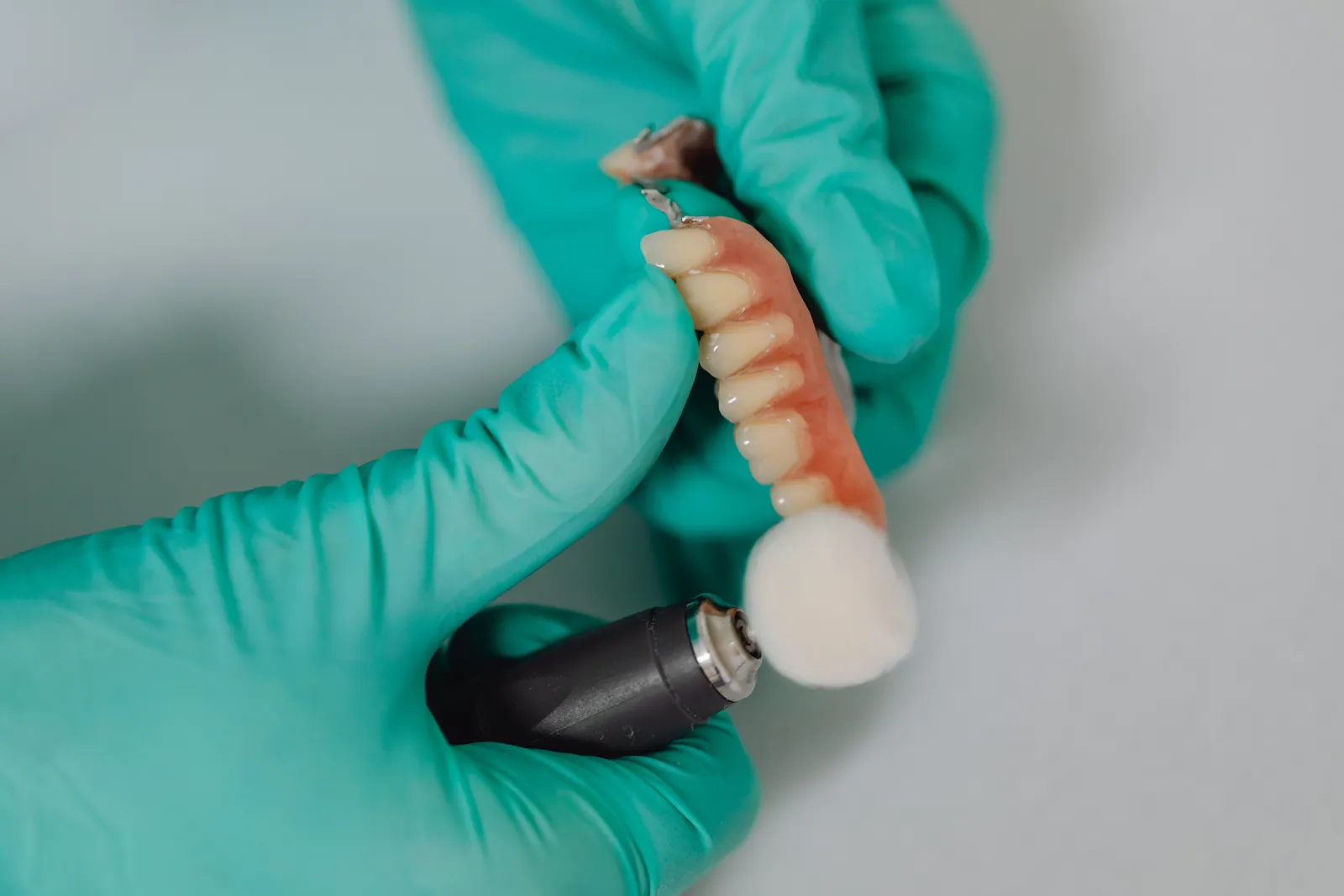
A removable partial denture usually costs least up front. It is a replacement tooth on a plastic base or a thin metal frame, with clasps that hook around the neighboring teeth.
It costs less because it asks little on the day: no surgery, no healing time, and little or no reshaping of the neighbors.
The tradeoffs come from how it sits on the gum, where part of the chewing force presses into the gum and the bone beneath it. That bone keeps shrinking, so the fit loosens and the base needs refitting or remaking. The clasps also hold plaque against the teeth they grip, so those teeth need careful daily brushing.
A Dutch study of 886 metal-frame partial dentures found half had been replaced or were no longer worn after 10 years (Vermeulen et al., 1996). Our post on why dentures get loose covers the refitting side.
Why does a bridge cost more, and what does it ask of the teeth beside the gap?
A dental bridge is three joined crowns: the middle one fills the gap, and the outer two are cemented over the teeth on either side. It stays in, and you clean under the false tooth with a floss threader.
To fit a crown, the dentist shaves the tooth down on every side to make room. A lab study on model back teeth found a full crown preparation removed 68 to 76 percent of the tooth above the gumline.
Whether that is a cost depends on the neighbors. If they already carry large fillings or old crowns, they need that coverage anyway, and the bridge does two jobs at once. If they are healthy and unfilled, a bridge removes sound tooth to replace one that is gone. The ridge under the false tooth also has no root to hold its shape, so it can keep thinning.
A review of 19 long-term studies estimated that 89 of every 100 bridges were still in place after 10 years. Only 71 of every 100 went that long without a problem of any kind.
The redo is where the cost sits. The most common problems are decay at the edge of a support crown and the nerve dying inside a support tooth (Pjetursson et al., 2007). Either one strikes a tooth that holds up all three, and if it cannot be saved, the gap becomes two teeth wide.
Why does an implant cost the most up front?
A dental implant replaces the root as well as the tooth, with a small titanium post placed in the bone where the root was. Over several months the bone grows tight against its surface, and then a connector and a crown go on top.
It costs the most because there are more parts and more steps. Planning starts with a 3D scan (CBCT) that shows the height and width of the bone, and placement is a surgery done under local anesthetic. If the ridge has thinned since the extraction, a bone graft can come first. The healing months, the connector and the crown each add a line to the estimate.
What that buys is the one option that leaves the neighbors alone: no clasp grips them and no crown covers them. The post also carries chewing force into the bone, the way a root does.
A review of 46 studies found 95 of every 100 implants still in place after 10 years. The crowns on top did less well, at 89 of every 100. The same review found a loose screw in about 9 of every 100 implant crowns within five years.
So when an implant needs work, it is more often the crown or the screw on top than the post in the bone. An implant cannot decay, but the gum and bone around it can still become infected. It needs the same daily cleaning and checkups as a natural tooth.
Which option costs least over the years?
Side by side, the four choices look like this.
- Leaving the gap costs nothing now, and later it can cost bone and the straight line of the neighbors.
- A partial denture costs least up front, grips the neighbors with clasps and needs refitting or replacing over the years.
- A bridge costs more, uses the two neighbors as supports, and its redo involves those teeth.
- An implant costs most up front, leaves the neighbors alone, and its redo is usually the crown on top.
Which one costs you least depends on the teeth beside the gap and the bone under it. That is why the honest answer comes after an exam and X-rays, not from a price list.
How do we build your estimate at Front Royal Dental Group?
We do the extraction itself and offer partial dentures, bridges and implants, so you can compare all four choices in one place. Dr. Ezzat Abdoun completed the implant program at Columbia University College of Dental Medicine, and single implants are among the cases he works on most. If you lean toward an implant, we plan it from a 3D scan of your bone and can place it with guided implant surgery.
After the exam, you receive a written estimate for the options that fit your mouth, before treatment begins. Ask what each one will need redone first, and what that redo involves.
If you have insurance, we check your benefits with the carrier rather than guessing from the card. We work with many PPO plans and accept Virginia Medicaid through DentaQuest, so call to verify your specific plan. Ask, too, how your plan treats each option, because plans differ on implants. Treatment can often be phased, and you decide what happens next, with the numbers in front of you.
Ready to get started? Schedule a visit with Front Royal Dental Group, or call (540) 636-2003.
More from Our Blog

Is Flossing Actually Necessary?
A daily clean between your teeth is necessary, since a toothbrush cannot reach the spot where two teeth touch. The 2016 news reports found the flossing studies were short and weak, which leaves the benefit unproven rather than disproven.
Read more
White Spots on Teeth: What Causes Them and What Fixes Them
Three common causes leave white spots on teeth: early decay, too much fluoride while the teeth were forming, and enamel that formed with too little mineral. Which one you have decides whether the spot can fade and what fixes it.
Read more
Gap or Crooked Front Tooth: Aligners, Bonding or Veneers?
Aligners move the tooth, bonding builds it up, and veneers cover it. Which one fits depends on whether the gap comes from spare room or a small tooth, where the tooth sits, its color and your bite, and sometimes the answer is two of them in order.
Read more