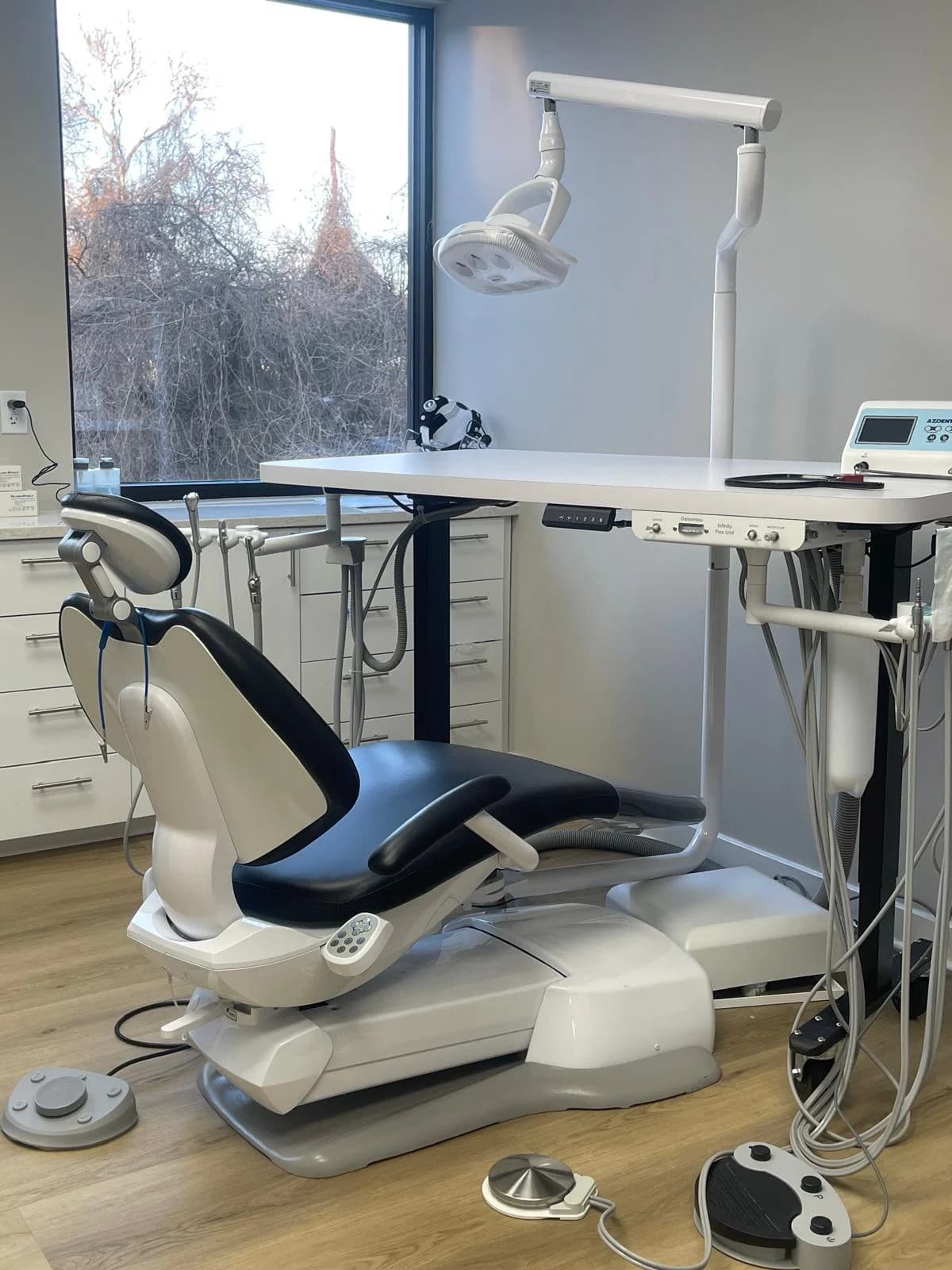
If you are typing this question into a search bar, you are probably not asking about pain in general. You are picturing a drill in your jawbone and wondering whether you could lie still for it.
The honest answer splits into three moments: the surgery itself, the first few days, and every year after the implant has healed. The feeling is different in each one, and so is the reason.
One thing first, because it changes how you weigh the rest. Front Royal Dental Group does not offer sedation of any kind. Your comfort during surgery comes from local anesthetic, an unhurried pace, and the fact that you can pause at any time. If you already know you could not get through surgery awake, you are better off learning that now than on the day.
Does it hurt during the surgery?
The area is numbed first, and how the numbing works is worth knowing, because it also tells you what you may feel instead.
Local anesthetic works by blocking the nerves that carry pain from one area of your mouth (ADA MouthHealthy). It does not block every kind of nerve equally. A review of local anesthetic pharmacology in BJA Education describes a differential block. The fibers that carry sharp pain are among the most susceptible. Fibers that report touch and position can still send signals when pain is blocked.
In plain terms, you may feel pushing, pressure or vibration in a numb mouth without it being pain.
Before any of this, a 3D scan shows where your bone is and where the nerves run, and the implant is planned from that scan. You can read how that works on our guided implant surgery page.
Dr. Ezzat Abdoun tells patients they are in control and can pause any time they need, and he takes it step by step. If something feels sharp rather than like pressure, say so and ask to pause.
What do the first few days feel like?
Once the numbness wears off, the surgery site behaves like any wound. A 2021 systematic review puts it this way: pain and swelling are common consequences of surgical trauma, driven by inflammatory chemicals the body releases. The same review says the pain is usually mild or moderate, although some patients have severe pain.
That "some patients" matters, and two studies show how wide the range is.
One prospective survey phoned 40 patients, with 98 implants between them, every day for a week. On day one, 52.5% rated their pain 8 to 10 out of 10 at some point in the day. That fell to 22.5% on day two and 12.5% on day three.
The most serious difficulty was swelling, which became minimal after about five days. Bruising was barely noticeable, and 75% had trouble eating on day one. The authors concluded that patients should expect recovery within about four days.
A 108-patient study counted differently, across the whole first week: 13.9% reported no pain, 55.6% mild pain and 30.6% moderate or intense pain.
The two studies used different patients and different ways of counting, so their numbers do not line up. Neither one is a promise about you.
What they agree on is the shape of the curve: the first day or two are the hardest, and it bends down from there. Where in the mouth the implant goes can matter too. The 40-patient survey found that implants placed between the canine teeth meant trouble eating for nearly a week. Ask at your consultation what to expect for your case and what to take for soreness, and follow that advice.
When should you call after implant surgery?
The studies describe pain that falls each day and swelling that has mostly settled by about day five. That makes the pattern, not the number, the thing to watch.
A review of local complications in implant surgery says infections arising in the first few postoperative days present with edema, exudate and pain. Soreness is expected.
Three things do not fit that pattern. One is pain that climbs instead of easing. Another is swelling that is still growing after the first several days. The third is fluid or pus coming from the site. Any of them is a reason to call the office at (540) 636-2003 rather than wait it out.
Can a healed implant hurt like a cavity?
Not the way a cavity does. A cavity aches because decay travels toward the nerve inside a tooth, and an implant has no such nerve for anything to reach. An implant is a titanium post that the bone grows around and holds in place (ADA MouthHealthy). There is no tooth nerve in it, and nothing in it can decay.
That is not the same as nothing around it can go wrong. The gum and bone around an implant are living tissue, and plaque can inflame them.
The American Academy of Periodontology separates two stages. In peri-implant mucositis, the inflammation stays in the soft tissue, with no bone loss. In peri-implantitis, the bone supporting the implant begins to break down. The signs it lists for patients are red or tender gums around the implant and bleeding when you brush. A 2020 consensus report found that non-surgical cleaning and better home care are useful for treating the earlier stage.
So a quiet implant is not proof of a healthy one. Bleeding gums around it are worth a call.
What if you are nervous about all of this?
You are not alone if you are nervous about this, and it deserves a plain plan. Say so when you call and when you sit down, and ask to pause whenever you need to. Our posts on being nervous about the dentist and on coming back after years away cover what that first conversation is like.
The exam and imaging come first, and you decide what happens next with the plan in front of you. For the full picture of the treatment, see dental implants in Front Royal and our dental implants page.
Ready to get started? Schedule a visit with Front Royal Dental Group, or call (540) 636-2003.
More from Our Blog

Does Whitening Toothpaste Actually Whiten Your Teeth?
Whitening toothpaste can lift stain from the surface of your teeth. It does not change the color inside them, and a harsher paste does not make that any better.
Read more
Jaw Clicking or Popping: When It Is Harmless and When It Is Not
Jaw clicking is usually a small cartilage disc moving over the jawbone. With no pain and no locking, it needs no treatment. Pain, locking or a mouth that opens less is the point to get it checked.
Read more
Dental X-Rays: How Much Radiation, and How Often Do You Need Them?
Four bitewings measured 5 microsieverts in one lab study, about half a day of natural background radiation. How often you need them depends on your cavity risk, from every 6 to 18 months down to every 24 to 36.
Read more