You sit down for your exam and the assistant picks up the sensor. A thought you have had before comes back: X-rays mean radiation, so can you skip them this time? It is a fair question, and it has a measurable answer. This post gives the dose of dental X-rays with its source and shows what a bitewing finds that a mirror cannot. It then explains how often an adult needs one, and what moves that number.
How much radiation is in a dental X-ray?
A dental X-ray aims its beam at a small patch of your jaw and not at the rest of your body. The dose is still not zero, so it helps to put a number on it.
The unit is the microsievert (µSv), an effective dose that weighs how sensitive each exposed organ is to radiation. That weighting is what lets you compare a jaw X-ray with a chest X-ray or with an ordinary day outdoors.
A 2008 study in the Journal of the American Dental Association measured common dental exams on a tissue-equivalent head model. With digital receptors or fast film and a rectangular beam, four bitewings delivered 5.0 µSv and a full-mouth series delivered 34.9 µSv.
Those numbers mean more next to a few familiar ones. The ADA reports that Americans receive about 3.1 millisieverts a year from natural sources such as soil and radon. That is 3,100 µSv a year, or about 8.5 µSv a day. That division is our own arithmetic, a comparison and not a figure the ADA or the study gives. By it, four bitewings equal roughly 14 hours of natural background and a full-mouth series about four days.
The FDA lists a front-view chest X-ray at 0.02 millisieverts, which is 20 µSv. Studies use different methods, so read these figures as the same order of magnitude and not as an exact ratio. The ADA adds that dental imaging makes up less than 1 percent of the collective dose Americans receive from medical imaging.
Equipment changes the number a great deal. In that same study a full-mouth series with a round beam measured 170.7 µSv, and with a round beam and slow D-speed film, 388 µSv. The FDA's guidance says a rectangular beam cuts dose by up to fivefold compared with a round one. It adds that digital imaging can cut the dose another 40 to 60 percent.
Front Royal Dental Group takes digital X-rays, which our post on digital dentistry covers. Your own dose still depends on the settings used, so you are free to ask about them.
Is the dose zero? No, and the ADA says the effects of X-ray exposure accumulate from multiple sources over time. Its rule is that each exposure be justified by its benefit to you. Necessary exposures are then kept as low as reasonably achievable, which is why frequency matters.
What does a bitewing show that a mirror cannot?
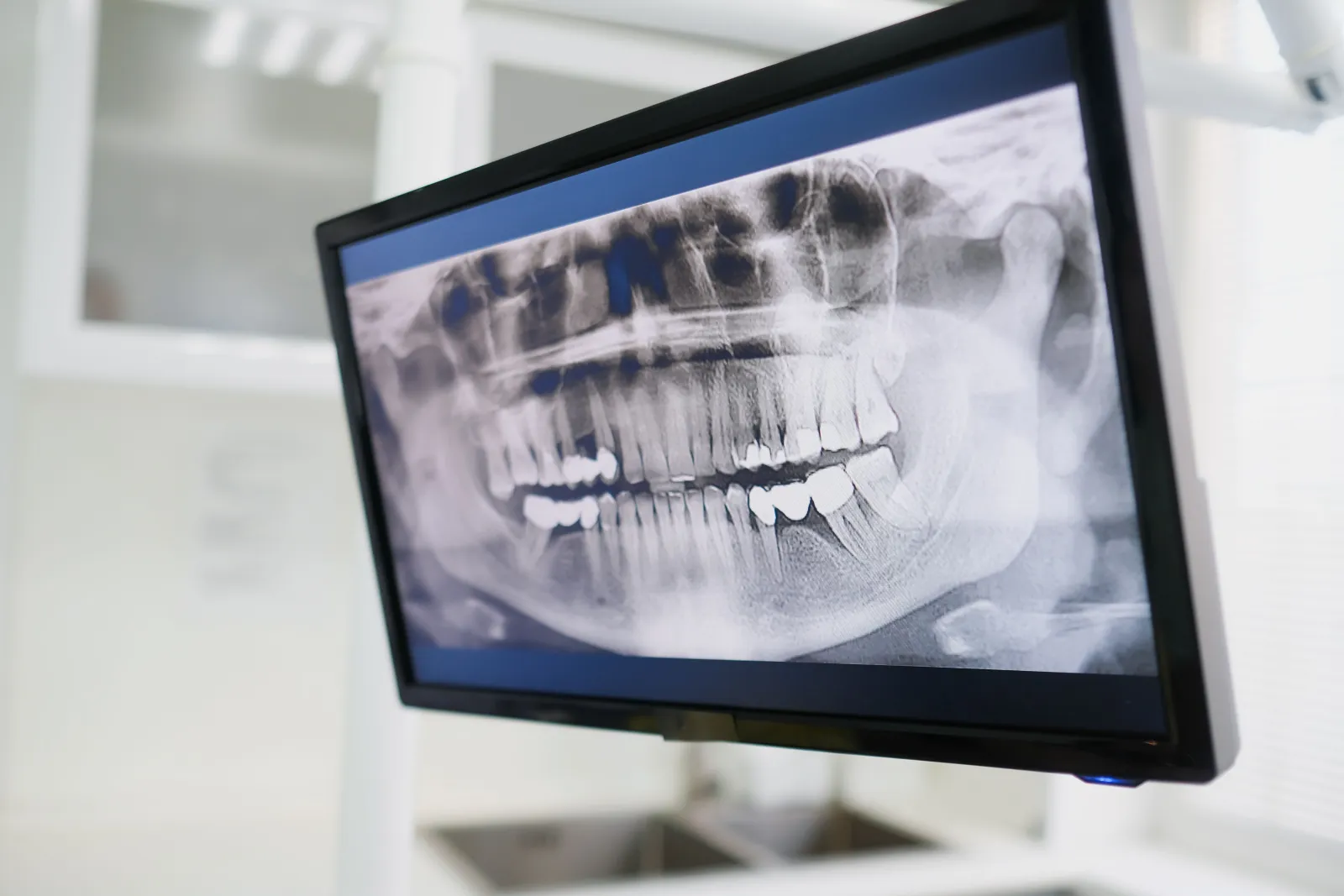
A bitewing sensor sits between your upper and lower back teeth while you bite on a small tab. The beam passes sideways through the crowns and the bone below them.
Dense material absorbs more of the beam, so enamel, bone and metal fillings show up pale. Decay is enamel that has lost its mineral, so it absorbs less and shows as a darker patch.
This matters most where two teeth touch, because a mirror often cannot see that surface and a probe cannot always reach into it. Our post on how cavities form explains why decay there stays quiet. The part of a tooth that feels pain is the last part decay reaches.
A bitewing also shows the height of the bone between your teeth, which is how your dentist tracks gum disease over the years. It shows the size of an old filling and whether decay has started along its edge.
You can decline any X-ray, and what you give up is the part of the exam that depends on the picture. An exam without it cannot rule out decay between teeth or check your bone level. Those are two of the main findings a bitewing exists to catch.
How often do you need dental X-rays?
The ADA's recommendations on frequency say there is no "one size fits all" interval. The ADA and FDA's earlier 2012 selection guidance gave ranges, not fixed dates. It said the dentist uses professional judgment to pick the right time within a range.
The current ADA and American Academy of Oral and Maxillofacial Radiology recommendations were published in January 2026. For adults with their own teeth, the table sets the bitewing intervals this way.
With no cavities and no increased risk, bitewings come every 24 to 36 months. With cavities now, or at increased risk, they come every 6 to 18 months. For gum disease the choice is clinical judgment, usually selected bitewings or other images of the areas where disease shows.
A new patient gets an individualized set based on signs and symptoms. A full-mouth set is preferred when there is generalized disease or a history of extensive treatment.
These ranges are a starting point that a dentist adjusts to the patient in the chair. The recommendations say the decision rests on your histories, a clinical exam and any earlier images. Screening X-rays do not come before the exam.
What moves you toward more X-rays, or fewer?
Your risk of new decay sets the interval. The FDA and ADA selection guidance names current cavities as one marker. It lists poor oral hygiene, frequent sugar-containing foods and too little fluoride as factors that raise the risk. It also tells dentists to watch adults for recurrent decay, the kind that returns next to an earlier filling. The guidance adds that risk changes over time, so your interval can change with it.
A person with cavities now or several of these factors belongs at the shorter end of the range. Our post on dry mouth and sudden cavities shows how one medication can raise a person's decay risk. Our how cavities form post says a year since your last X-rays is worth a question. For someone with recent cavities, that fits the 6-to-18-month window.
The FDA guidance describes an adult who gets regular professional care and has no signs of disease as low risk. That person fits the 24-to-36-month end of the range. The ADA also asks dentists to make a good-faith attempt to use X-rays from your previous exams. If you are changing offices, ask your old dentist for your X-rays and bring them.
Does pregnancy change the answer?
Tell the team you are pregnant before any imaging. The ADA's page notes that studies of pregnant patients receiving dental care have affirmed the safety of dental treatment. Its 2024 expert panel dropped thyroid and abdominal shielding for all patients, pregnancy included. A lead collar can block the beam and force a retake, which means a second exposure.
So the question is the same one anyone gets: will this image change what is done?
What should you ask at your next visit?
Three questions cover it. What are you looking for with this image, and how will the result change what we do? When were my last X-rays, and what interval fits my risk?
A good answer names something measured, such as your cavity history or your bone level, and you decide from there. At a first visit, the new patient exam is where that conversation starts. Our first-visit post explains what happens during that visit.
Ready to get started? Schedule a visit with Front Royal Dental Group, or call (540) 636-2003.
More from Our Blog

Full Mouth Dental Implants: What 'Full Mouth' Actually Means
Full mouth dental implants rarely means one implant for every tooth. The phrase covers four different designs, and what holds the teeth in each one decides how many implants you need.
Read more
Replacing One Missing Tooth: Every Option and What Drives Its Cost
A removable partial denture usually costs least up front, a bridge sits in the middle and an implant costs most. The price follows what each option asks of the teeth beside the gap and of the bone, and what it takes to redo it.
Read more
Is Flossing Actually Necessary?
A daily clean between your teeth is necessary, since a toothbrush cannot reach the spot where two teeth touch. The 2016 news reports found the flossing studies were short and weak, which leaves the benefit unproven rather than disproven.
Read more